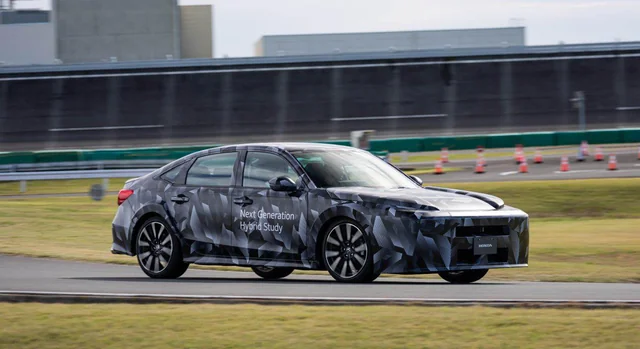
2027 Honda Civic Hybrid
Honda is already laying the groundwork for its next-generation hybrid future, and the protagonist in this story is the 2027 Civic Hybrid prototype. Recently, automotive journalists got behind the wheel of this heavily camouflaged test mule at Honda’s Tochigi Proving Ground in Japan — and the early impressions are very promising. With a redesigned hybrid powertrain, weight savings, an updated chassis, and fresh driving dynamics, Honda is positioning this Civic Hybrid to be both efficient and fun.
A Bold Step in Hybrid Evolution
Under the hood, the prototype hides a new 2.0-liter Atkinson-cycle naturally aspirated engine, paired with a pair of electric motors — one for traction and one acting as a generator. This marks a major shift from Honda’s older hybrid systems.
What’s more interesting is that these electric motors are compact, more efficient, and free from rare-earth materials, highlighting Honda’s push toward sustainability. The battery too has been reworked: the redesigned unit now sits under the rear seat, which not only frees up space but also contributes to a significant weight reduction of around 175–200 pounds (about 80–90 kg) compared to the current Honda Civic Hybrid.
Driving Experience: Smooth, Responsive, and Engaging
On the test track at Tochigi, the prototype impressed with its balanced acceleration and seamless transitions between EV, hybrid, and engine drive modes. Reviewers say the throttle response is snappy, and there is a newfound fluidity in how the powertrain adapts to driving demands.
One novel feature is the “S+ Shift” mode — a simulated manual mode that brings in gear-shifting sensations, complete with paddle shifters. It’s not for performance gains, but for enhancing driving engagement. During testing, drivers experienced upshifts and downshifts accompanied by a low, sporty engine note — surprisingly reminiscent of the Civic Si.
Honda’s engineers also pointed out that the new chassis has some clever flex: the body slightly deforms under cornering, allowing tires to maintain better contact with the road, which results in more stability and grip. The steering feels sharp and well-weighted, and the suspension appears tuned to reduce road noise and vibrations — the cabin felt quiet and refined even at speed.
Inside: A More Digital and Minimal Cabin
Although the prototype was heavily disguised, the interior revealed key upgrades. The most noticeable change is the 15-inch landscape touchscreen, which is a big jump from the previous 9-inch unit. The central gear shifter has been replaced by a column-mounted selector, giving the center console a cleaner, more minimalist layout.
These changes reflect Honda’s ambition to give the Civic a more modern, digital-first feel — bridging the gap between traditional combustion models and future electrified vehicles.
Underlying Engineering: Lightweight and Modular
Honda’s next-gen platform plays a crucial role in the hybrid prototype’s dynamics. At a recent Honda Automotive Technology Workshop, the company revealed that this new midsize hybrid platform is lighter by about 90 kg (198 lbs). The architecture is also modular — modular enough to support a wide variety of electrified vehicles — which helps Honda share parts across models and keep costs under control.
In terms of body rigidity, Honda engineers have adopted an innovative control approach: by optimizing how the body flexes in turns, they’re able to improve both handling stability and driving feel.
Future Tech and Safety
Honda is not just stopping at performance. The company also plans to introduce the next-generation automated driving system (ADAS) in hybrids and EVs starting around 2027. Safety enhancements include a new airbag under the seat to better protect the pelvis — a first for Honda — and other advanced passive safety features.
When Will We See the Production Version?
According to Honda, the new hybrid system is expected to debut in the second half of 2026, but the production Civic Hybrid might reach global markets in early 2027.Although precise power figures haven’t been disclosed yet, the company seems confident about the performance gains and efficiency improvements over the current hybrid setup.
This advanced hybrid tech is likely to be shared across other Honda models too — such as the Accord, CR-V, and possibly the Prelude — thanks to the modular platform.
Why This Matters
- Improved Efficiency + Performance: The lighter car, more efficient motors, and refined engine mean better fuel economy without compromising driving fun.
- Sustainability Focus: The use of rare-earth-free motors shows Honda’s commitment to greener manufacturing.
- Modern Driving Experience: Features like S+ Shift, large touchscreen, and a minimalistic cabin deliver a more premium, tech-forward experience.
- Platform Sharing: A shared modular platform will help Honda scale this technology across many models, reducing costs and speeding up development.
- Safety & Autonomy: Enhanced safety features and future ADAS bring it in line with the expectations of next-gen hybrid buyers.
Final Thoughts
Honda’s 2027 Civic Hybrid prototype is not just an incremental upgrade — it’s a clear signal that the brand is serious about hybrid technology in the electrified era. With a lighter chassis, a completely reimagined powertrain, engaging driving dynamics, and a modern cabin, this Civic redefines what a hybrid can be. The test drive at the Tochigi Proving Ground suggests that Honda is striking a smart balance between efficiency and driving pleasure — something the Civic has always been known for.
If Honda executes this well, the next-gen Civic Hybrid could become a benchmark in its segment, appealing to both eco-conscious drivers and enthusiasts alike.